激發(fā)光源LUYOR-3415 RG篩選GFP轉(zhuǎn)基因大豆毛狀根
2025 年,華中農(nóng)業(yè)大學作物遺傳改良國家重點實驗室、植物科學技術(shù)學院聯(lián)合湖北省洪山實驗室、吉林省農(nóng)業(yè)科學院農(nóng)業(yè)生物技術(shù)吉林省重點實驗室在《Nature Plants》期刊發(fā)表文獻《The BRUTUS iron sensor and E3 ligase facilitates soybean root nodulation by monoubiquitination of NSP1》(IF=20.1,中科院一區(qū) Top 期刊),文獻中明確指出利用 LUYOR-3415 熒光蛋白激發(fā)光源可高效篩選 GFP 標記的轉(zhuǎn)基因大豆毛狀根,為解析大豆根瘤共生固氮的分子機制提供關(guān)鍵技術(shù)支撐。
華中農(nóng)業(yè)大學團隊利用 LUYOR-3415RG 熒光蛋白激發(fā)光源篩選 GFP 標記的轉(zhuǎn)基因大豆毛狀根
2025 年,華中農(nóng)業(yè)大學主導的研究團隊在《Nature Plants》發(fā)表重磅成果,揭示了鐵傳感器 BTSa 通過單泛素化修飾 NSP1a 調(diào)控大豆根瘤發(fā)育的核心機制。該研究中,LUYOR-3415RG 熒光蛋白激發(fā)光源作為關(guān)鍵工具,承擔了 GFP 標記轉(zhuǎn)基因大豆毛狀根的篩選任務(wù),其穩(wěn)定的熒光識別能力和高效的篩選效率為實驗成功奠定了基礎(chǔ)。
華中農(nóng)業(yè)大學作物遺傳改良國家重點實驗室是我國作物科學研究的核心陣地,圍繞農(nóng)業(yè)可持續(xù)發(fā)展的重大戰(zhàn)略需求,在作物遺傳育種、植物與微生物互作、營養(yǎng)信號調(diào)控等前沿領(lǐng)域開展系統(tǒng)研究。重點方向包括大豆共生固氮機制、作物營養(yǎng)高效利用、轉(zhuǎn)基因技術(shù)創(chuàng)新等,曾在 Nature 系列、Cell 等國際期刊發(fā)表多項突破性成果,為保障國家糧食安全提供重要理論支撐和技術(shù)儲備。
在該實驗中,研究團隊采用農(nóng)桿菌介導的大豆毛狀根轉(zhuǎn)化技術(shù),將 UBIpro:BTSa–4×MYC、UBIpro:NSP1a–4×MYC、NSP1apro:NSP1aWT–4×MYC 等載體(含 GFP 報告基因 cassette)轉(zhuǎn)入大豆毛狀根;轉(zhuǎn)化后的復合植株在培養(yǎng)箱中培養(yǎng) 7 天后,轉(zhuǎn)移至含不同鐵濃度的 BD–LN 營養(yǎng)液濕潤的蛭石中預處理 3 天,再接種慢生根瘤菌 USDA110;通過 LUYOR-3415 熒光蛋白激發(fā)光源可視化 GFP 綠色熒光,快速篩選陽性轉(zhuǎn)基因毛狀根,隨后進行根瘤計數(shù)、氮酶活性檢測及分子機制分析。
LUYOR-3415RG 熒光蛋白激發(fā)光源是一款專為轉(zhuǎn)基因生物篩選設(shè)計的快速檢測工具,采用充電電池供電,雙波長激發(fā)設(shè)計適配綠色 / 紅色熒光蛋白,續(xù)航能力強,既適用于實驗室常規(guī)篩選,也滿足野外原位觀察需求;配合專用支架可實現(xiàn)長時間穩(wěn)定觀察,避免人工手持疲勞。其單個波長配備 6×3W LED 發(fā)光模塊,照射面積廣,能快速完成大批量樣品篩選,顯著提升實驗效率;可靈活選配不同波長模塊,兼容 GFP、eGFP、DsRed、mCherry、TdTomato 等多種熒光蛋白,滿足多元化實驗需求。該產(chǎn)品操作簡便、熒光信號識別精準,已成為高校、科研院所轉(zhuǎn)基因?qū)嶒灥暮诵墓ぞ撸塾?/span>有近千篇高水平科研文獻發(fā)表。
原文段落
Legumes form root nodules with symbiotic nitrogen-fixing rhizobacteria, which require ample iron to ensure symbiosis establishment and efficient nitrogen fixation. The functions and mechanisms of iron in nitrogen-fixing nodules are well established. However, the role of iron and the mechanisms by which legumes sense iron and incorporate this cue into nodulation signalling pathways remain unclear. Here we show that iron is a key driver of nodulation because symbiotic nodules cannot form without iron, even under conditions of sufficient light and low nitrogen. We further identify an iron optimum for soybean nodulation and the iron sensor BRUTUS A (BTSa) which acts as a hub for integrating iron and nodulation cues. BTSa is induced by rhizobia, binds to and is stabilized by iron. In turn, BTSa stabilizes and enhances the transcriptional activation activity of pro-nodulation transcription factor NSP1a by monoubiquitination from its RING domain and consequently activates nodulation signalling. Monoubiquitination of NSP1 by BTS is conserved in legumes to trigger nodulation under iron sufficiency. Thus, iron status is an essential cue to trigger nodulation and BTSa integrates cues from rhizobial infection and iron status to orchestrate host responses towards establishing symbiotic nitrogen fixation.
Soybean hairy-root transformation and B. diazoefficiens inoculation assayHairy-root transformation with Agrobacterium rhizogenes K599 was carried out as previously described. In brief, 3-day-old seedlings were used for transformation. Transgenic composite plants were transferred to vermiculite in a growth chamber (16 h light/8 h dark, 25 °C, 50% relative humidity). For iron treatments, 7-day-old composite plants were transferred to vermiculite moistened with BD–LN nutrient solution with 10 µM Fe citrate or 200 µM AA-DP/2,2′-bipyridine for 3 d, and then inoculated with B. diazoefficiens USDA110, and hairy-root samples were collected for further analysis. Transgenic hairy roots transformed with UBIpro:BTSa–4×MYC, UBIpro:NSP1a–4×MYC, NSP1apro:NSP1aWT–4×MYC or NSP1apro:NSP1a5KR–4×MYC (with GFP in another cassette) were screened using a portable fluorescence lamp (LUYOR-3415, LUYOR) to visualize GFP fluorescence.
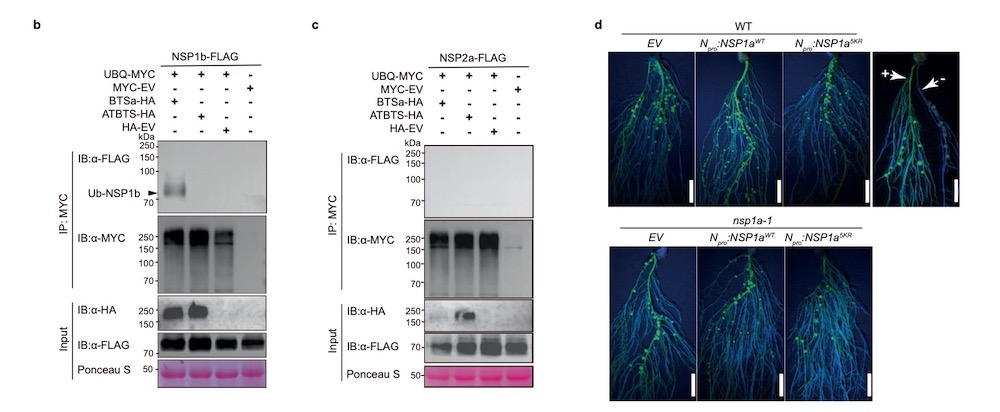

原文獻:10.1038/s41477-024-01896-5

© 2025 版權(quán)所有:上海路陽儀器有限公司 備案號:滬ICP備10002130號-7 總訪問量:303906 站點地圖 技術(shù)支持:化工儀器網(wǎng) 管理登陸


